

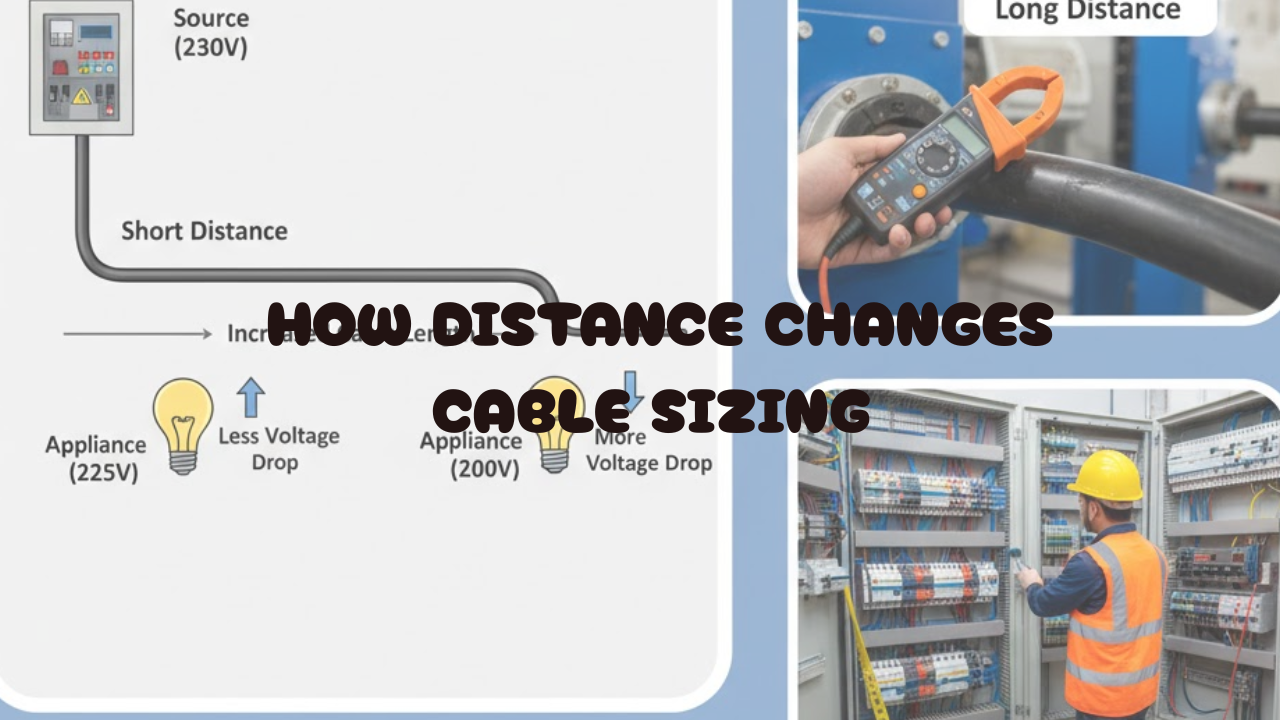
How Distance Changes Cable Sizing (Without Overcomplicating It)
When choosing electrical cables, most people in Malaysia focus on current (ampere) and cable size (mm²). That’s important — but there’s one factor that’s often overlooked and causes real problems on site:
👉 Distance
At See Kwong, we frequently see cables that are “technically connected” but practically underperforming — dim lights, weak motors, nuisance trips, and overheated cables. In many cases, the root cause is simple: the cable run is too long for the selected size.
Let’s explain this clearly, without complicated formulas.
The Simple Truth: Longer Distance = Bigger Cable Needed
Electricity doesn’t travel perfectly.
The longer the cable, the more voltage drop occurs.
👉 Voltage drop means:
Less voltage reaches the equipment
Devices work harder to compensate
Heat builds up in the cable
Efficiency and lifespan are reduced
Short distance → standard cable size usually OK
Long distance → cable size must increase
What Is Voltage Drop (In Plain Language)?
Think of electricity like water flowing in a pipe.
Short pipe → strong water pressure
Long pipe → pressure drops before reaching the endElectrical cables work the same The longer the cable:
Why Voltage Drop Matters (Especially in Malaysia)
Excessive voltage drop can cause:
Lights not bright enough
Motors overheating or failing early
Air-conditioners not starting properly
Electronic equipment malfunctioning
Increased energy loss (higher bills)
In Malaysia, standard practice (based on IEC / MS standards) is to keep voltage drop within:
≤ 3% for lighting circuits
≤ 5% for power circuits
Anything beyond this is a design problem — not a product problem.
A Practical Example (No Math, No Stress)
Let’s say you’re wiring:
A 20A load
Using a 4mm² cable
Distance: 10 metres
✅ Usually OK
Now change only one thing:
Distance becomes 40–50 metres
❌ Suddenly:
Voltage drop increases
Cable heats up
Equipment performance drops
👉 Solution:
Increase cable size to 6mm² or 10mm², depending on the load and installation method.
Same current. Same equipment.
Only distance changed — AND cable size must change too.
❌ “Ampere Rating Is Enough”
Amp rating alone does not consider distance.
❌ “It Works, So It’s Fine”
It may work today — but long-term heating and voltage drop will damage equipment.
❌ “Bigger MCB Will Solve It”
Incorrect. Bigger protection without correct cable size is dangerous.
❌ “Contractor Always Use This Size”
Standard practice is not always correct for every installation.
Simple Rule of Thumb (For Early Planning)
While final sizing should always be calculated, here’s a general guide:
Up to 15–20m → standard size usually sufficient
20–40m → check voltage drop carefully
Above 40m → expect to increase cable size
Correct cable sizing:
Reduces heat
Prevents nuisance tripping
Improves equipment lifespan
Saves energy long-term
Improves overall system safety
How See Kwong Helps
✔ Supplying IEC / MS-compliant cable selection
✔ Suitable for residential, commercial & industrial use
✔ Support for long-distance and high-load applications
✔ Reliable cable brands with proven performance
Just tell us:
Load type & current
Distance of cable run
Installation environment
